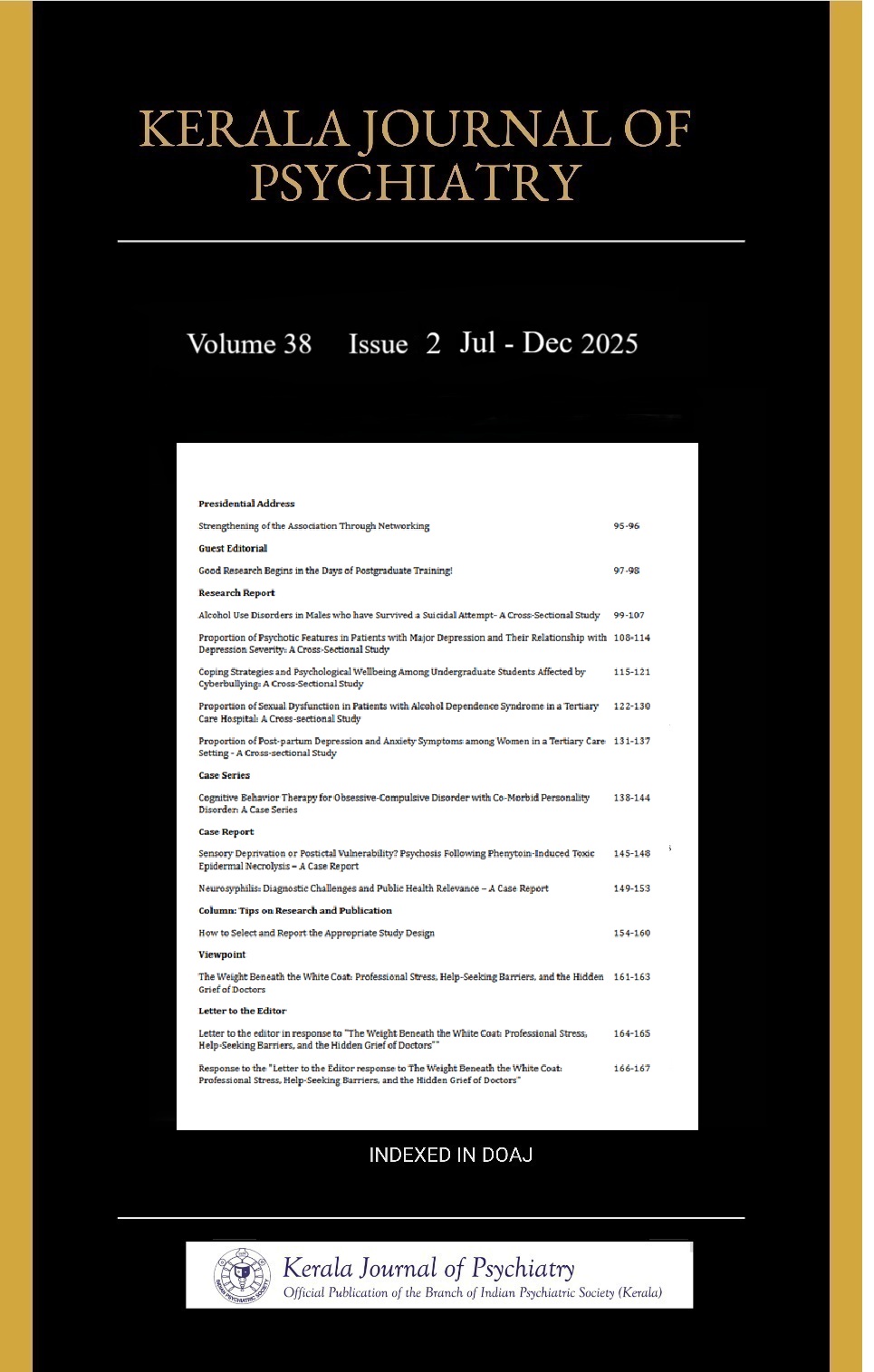
Cognitive Behavior Therapy for Obsessive-Compulsive Disorder with Co-Morbid Personality Disorder: A Case Series
DOI:
https://doi.org/10.30834/KJP.38.2.2025.517Keywords:
Obsessive-Compulsive disorder, Personality disorders, Co-morbidity , Cognitive behaviour therapy , Therapeutic EfficacyAbstract
Background – There have been contrasting results regarding the influence of co-morbid personality disorder (PD) on cognitive behaviour therapy (CBT) outcomes for anxiety disorders. This case series examines the efficacy and challenges of CBT for patients with obsessive-compulsive disorder (OCD) and comorbid PD.
Case Series: For the present case series, three individuals with the diagnosis of OCD were selected. They also presented with comorbid obsessive compulsive PD (OCPD), anxious avoidant PD, and dependent PD, respectively, as assessed by the ICD-10 International Personality Disorder Examination (IPDE). The Yale-Brown Obsessive-Compulsive Scale (Y-BOCS) was administered to assess the severity of OCD in the patients. They underwent a variable number of CBT sessions.
Results: Pre- and post-intervention analyses showed reductions in Y-BOCS scores across the baseline, 2-month, and 4-month follow-ups, along with improvements in functioning, as evidenced by patient and informant feedback pre- and post-intervention. However, the patient with co-morbid OCPD had a fluctuating course of treatment outcome, and his poorer motivation and preoccupation with details interfered with the course of therapy.
Conclusion: CBT treatment plans of such groups of patients should be individualized to address the issues posed by comorbidity.
References
Butler AC, Chapman JE, Forman EM, Beck AT. The empirical status of cognitive-behavioral therapy: a review of meta-analyses. Clin Psychol Rev. 2006 Jan;26(1):17-31.DOI: 10.1016/j.cpr.2005.07.003
Markarian Y, Larson MJ, Aldea MA, Baldwin SA, Good D, Berkeljon A, Murphy TK, Storch EA, McKay D. Multiple pathways to functional impairment in obsessive-compulsive disorder. Clin Psychol Rev. 2010 Feb;30(1):78-88. DOI: 10.1016/j.cpr.2009.09.005
Friborg O, Martinussen M, Kaiser S, Overgård KT, Rosenvinge JH. Comorbidity of personality disorders in anxiety disorders: a meta-analysis of 30 years of research. J Affect Disord. 2013 Feb 20;145(2):143-55. DOI: 10.1016/j.jad.2012.07.004
Thamby A, Khanna S. The role of personality disorders in obsessive-compulsive disorder. Indian J Psychiatry. 2019 Jan; 61 (Suppl1): S114- S118. DOI: 10.4103/psychiatry.IndianJPsychiatry_526_18
Pinto A, Greene AL, Storch EA, Simpson HB. Prevalence of Childhood Obsessive-Compulsive Personality Traits in Adults with Obsessive Compulsive Disorder versus Obsessive Compulsive Personality Disorder. J Obsessive Compuls Relat Disord. 2015 Jan 1; 4:25-29. DOI: 10.1016/j.jocrd.2014.11.002
Park JM, Storch EA, Pinto A, Lewin AB. Obsessive-Compulsive Personality Traits in Youth with Obsessive-Compulsive Disorder. Child Psychiatry Hum Dev. 2016 Apr;47(2):281-90. DOI: 10.1007/s10578-015-0565-8
Wang Y, Miguel C, Ciharova M, Amarnath A, Lin J, Zhao R, Toffolo MBJ, Struijs SY, de Wit LM, Cuijpers P. The effectiveness of psychological treatments for obsessive-compulsive disorders: a meta-analysis of randomized controlled trials published over last 30 years. Psychol Med. 2024 Aug;54(11):2838-2851. DOI: 10.1017/S0033291724001375
Polak M, Tanzer NK. Internet-Based Cognitive Behavioural Treatments for Obsessive-Compulsive Disorder: A Systematic Review and Meta-Analysis. Clin Psychol Psychother. 2024 May-Jun;31(3): e2989. DOI: 10.1002/cpp.2989
Harte CB, Hawkins RC II. Impact of personality disorder comorbidity on cognitive-behavioral therapy outcome for mood and anxiety disorders: results from a university training clinic. Res in Psychother Psychopath Proc and Outco. 2016;19(2). DOI:10.4081/ripppo.2016.210
Leibbrand R, Hiller W, Fichter MM. Effect of comorbid anxiety, depressive, and personality disorders on treatment outcome of somatoform disorders. Compr Psychiatry. 1999 May-Jun;40(3):203-9. DOI: 10.1016/s0010-440x(99)90004-4
Dreessen L, Arntz A. The impact of personality disorders on treatment outcome of anxiety disorders: best-evidence synthesis. Behav Res Ther. 1998 May;36(5):483-504. DOI: 10.1016/s0005-7967(98)00026-6
Weertman A, Arntz A, Schouten E, Dreessen L. Influences of beliefs and personality disorders on treatment outcome in anxiety patients. J Consult Clin Psychol. 2005 Oct;73(5):936-44. DOI: 10.1037/0022-006X.73.5.936
Kuyken W, Kurzer N, DeRubeis RJ, Beck AT, Brown GK. Response to cognitive therapy in depression: the role of maladaptive beliefs and personality disorders. J Consult Clin Psychol. 2001 Jun;69(3):560-6. DOI: 10.1037//0022-006x.69.3.560
Loranger AW, Sartorius N, Andreoli A, Berger P, Buchheim P, Channabasavanna SM, et al. The International Personality Disorder Examination. The World Health Organization/Alcohol, Drug Abuse, and Mental Health Administration international pilot study of personality disorders. Arch Gen Psychiatry. 1994 Mar;51(3):215-24. DOI: 10.1001/archpsyc.1994.03950030051005
Sharan P, Kulhara P, Verma SK, Mohanty M. Reliability of the icd-10 international personality disorder examination (ipde) (hindi version): a preliminary study. Indian J Psychiatry. 2002 Oct;44(4):362-4. PMCID: PMC2955308
Woody SR, Steketee G, Chambless DL. Reliability and validity of the Yale-Brown Obsessive-Compulsive Scale. Behav Res Ther. 1995 Jun;33(5):597-605. DOI: 10.1016/0005-7967(94)00076-v
Halder S, Singh AR, Prakash J. Efficacy of Cognitive behavior therapy for the treatment of OCD: A case report. Indian Journal of Clinical Psychology, 2005; 32: 133-136. https://www.researchgate.net/publication/272357975
Pinto A, Liebowitz MR, Foa EB, Simpson HB. Obsessive compulsive personality disorder as a predictor of exposure and ritual prevention outcome for obsessive compulsive disorder. Behav Res Ther. 2011 Aug;49(8):453-8. DOI: 10.1016/j.brat.2011.04.004
Gordon OM, Salkovskis PM, Bream V. The Impact of Obsessive Compulsive Personality Disorder on Cognitive Behaviour Therapy for Obsessive Compulsive Disorder. Behav Cogn Psychother. 2016 Jul;44(4):444-59. DOI: 10.1017/S1352465815000582
Coles ME, Pinto A, Mancebo MC, Rasmussen SA, Eisen JL. OCD with comorbid OCPD: a subtype of OCD? J Psychiatr Res. 2008 Mar;42(4):289-96.DOI: 10.1016/j.jpsychires.2006.12.009
Zerdzinski M, Burdzik M, Debski P, Zmuda R, Piegza M, Gorczyca P. The impact of obsessive-compulsive personality disorder on obsessive-compulsive disorder: clinical outcomes in the context of bipolarity. Front Psychiatry. 2025 Apr 24; 16:1532966. DOI: 10.3389/fpsyt.2025.1532966
Dreessen L, Hoekstra R, Arntz A. Personality disorders do not influence the results of cognitive and behaviour therapy for obsessive compulsive disorder. Journal of Anxiety Disorders. 1997; 11(5):503–521.DOI: 10.3389/fpsyt.2025.1532966
Lampe L, Malhi GS. Avoidant personality disorder: current insights. Psychol Res Behav Manag. 2018 Mar 8; 11:55-66. DOI: 10.2147/PRBM.S121073
Bender DS. The therapeutic alliance in the treatment of personality disorders. J Psychiatr Pract. 2005 Mar;11(2):73-87. DOI: 10.1097/00131746-200503000-00002
Ergin E, Alkar OY. Effectiveness of cognitive behavioral therapy in Cluster C personality disorders. Psikiyatride Guncel Yaklasimlar - Curr Appr in Psych. 2022;14(2):185–194. http://www.cappsy.org/archives/vol14/no2/cap_14_02_06_en.pdf
Published
Issue
Section
License
Copyright (c) 2025 Susmita Halder, Arpita Roy Choudhury (Author)

This work is licensed under a Creative Commons Attribution-NonCommercial 4.0 International License.