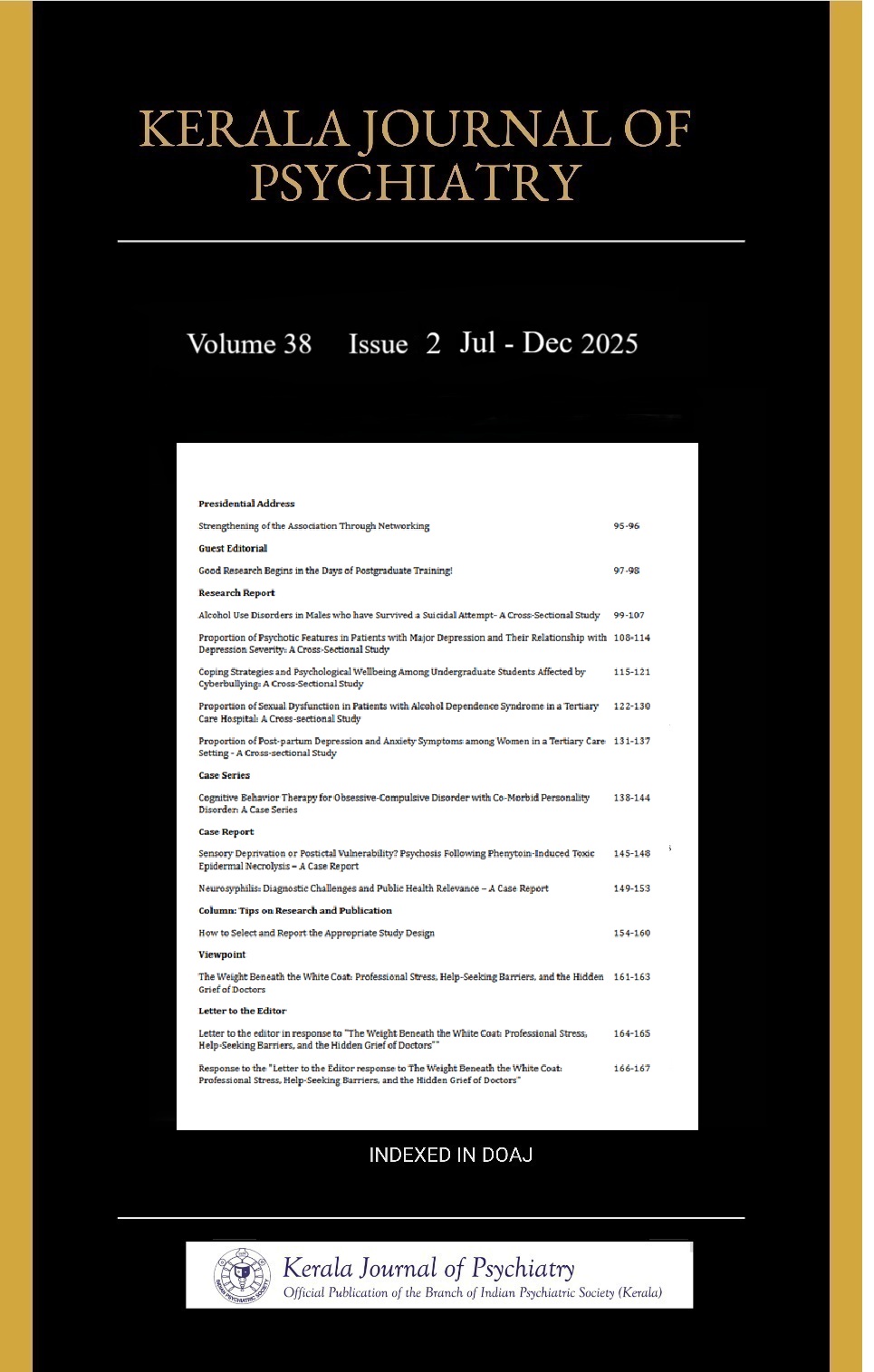
Proportion of Post-partum Depression and Anxiety Symptoms among Women in a Tertiary Care Setting - A Cross-sectional Study
DOI:
https://doi.org/10.30834/KJP.38.2.2025.536Keywords:
Post-partum, Depression, Anxiety, Woman's Mental Health, ScreeningAbstract
Background: Postpartum depression (PPD) and anxiety are mental health problems in females, and many factors predispose the occurrence of this illness. The study assessed the prevalence of postpartum depression and anxiety among postnatal mothers.
Materials and Methods: A hospital-based cross-sectional study was conducted among 200 women admitted to a tertiary care hospital in North India between March 2023 and April 2023. The Edinburgh Postnatal Depression Scale (EPDS) and the Patient Health Questionnaire-4 4 (Anxiety) were used to estimate the post-partum depression and anxiety, respectively.
Results: The mean age of the study subjects was 26.41 (SD = 5.292), and most of them belonged to rural backgrounds (64%). The prevalence of postpartum depression and anxiety was 30.5% (EPDS score of 10 and above) and 24% (PHQ score of 3 and above), respectively. Younger age (less than 35 years), rural background, low family income, complications during pregnancy, and low birth weight of the child were significantly associated with post-partum depression and anxiety in this setting (p <0.05).
Conclusion: The findings of the present study revealed that nearly 20%-30% of study subjects had postpartum psychological distress in this setting. Depression is often not diagnosed during postpartum, which emphasizes the need for similar screening practices in obstetrical and primary care.
References
Dai F, Cai Y, Chen M, Dai Y. Global trends of depressive disorders among women of reproductive age from 1990 to 2021: a systematic analysis of burden, sociodemographic disparities, and health workforce correlations. BMC Psychiatry. 2025 Mar 20;25(1):263. DOI: 10.1186/s12888-025-06697-4
World Health Organization. Depressive disorder (depression) [Fact sheet]. 2024. Available at: https://www.who.int/news-room/fact-sheets/detail/depression [Last accessed on 08 November 2025]
Howard LM, Khalifeh H. Perinatal mental health: a review of progress and challenges. World Psychiatry. 2020 Oct;19(3):313-327. DOI: 10.1002/wps.20769
Ojomo O, Atibioke O, Alesinloye-King O, Erlandsson K, Ängeby K, Envall N. A scoping study of postpartum mental health problems and associated factors: opportunities for research and practice. Discov Ment Health. 2025 Sep 8;5(1):136. DOI: 10.1007/s44192-025-00278-3
Kingston D, Kehler H, Austin MP, Mughal MK, Wajid A, Vermeyden L, et al. Trajectories of maternal depressive symptoms during pregnancy and the first 12 months postpartum and child externalizing and internalizing behavior at three years. PLoS One. 2018 Apr 13;13(4): e0195365. DOI: 10.1371/journal.pone.0195365
Vliegen N, Casalin S, Luyten P. The course of postpartum depression: a review of longitudinal studies. Harv Rev Psychiatry. 2014 Jan-Feb;22(1):1-22. DOI: 10.1097/HRP.0000000000000013
Yuan M, Zhu Z, Zeng T, Zhang K. Intimate partner violence and postpartum depression: a moderated mediation model of fear of birth and antenatal care. BMC Public Health. 2025 Nov 17;25(1):4003. DOI: 10.1186/s12889-025-25255-x
Bellerose M, Rodriguez M, Vivier PM. A systematic review of the qualitative literature on barriers to high-quality prenatal and postpartum care among low-income women. Health Serv Res. 2022 Aug;57(4):775-785. DOI: 10.1111/1475-6773.14008
Jain A, Tyagi P, Kaur P, Puliyel J, Sreenivas V. Association of birth of girls with postnatal depression and exclusive breastfeeding: an observational study. BMJ Open. 2014 Jun 9;4(6): e003545. DOI: 10.1136/bmjopen-2013-003545
Cox JL, Holden JM, Sagovsky R. Detection of postnatal depression. Development of the 10-item Edinburgh Postnatal Depression Scale. Br J Psychiatry. 1987 Jun; 150:782-6. DOI: 10.1192/bjp.150.6.782
Kroenke K, Spitzer RL, Williams JB, Monahan PO, Löwe B. Anxiety disorders in primary care: prevalence, impairment, comorbidity, and detection. Ann Intern Med. 2007 Mar 6;146(5):317-25. DOI: 10.7326/0003-4819-146-5-200703060-00004
Gavin NI, Gaynes BN, Lohr KN, Meltzer-Brody S, Gartlehner G, Swinson T. Perinatal depression: a systematic review of prevalence and incidence. Obstet Gynecol. 2005 Nov;106(5 Pt 1): 1071-83. DOI: 10.1097/01.AOG.0000183597.31630.db
Gelaye B, Rondon MB, Araya R, Williams MA. Epidemiology of maternal depression, risk factors, and child outcomes in low-income and middle-income countries. Lancet Psychiatry. 2016 Oct;3(10):973-982. DOI: 10.1016/S2215-0366(16)30284-X
Upadhyay RP, Chowdhury R, Aslyeh Salehi, Sarkar K, Singh SK, Sinha B, et al. Postpartum depression in India: a systematic review and meta-analysis. Bull World Health Organ. 2017 Oct 1;95(10):706-717C. DOI: 10.2471/BLT.17.192237
Patel V, Rodrigues M, DeSouza N. Gender, poverty, and postnatal depression: a study of mothers in Goa, India. Am J Psychiatry. 2002 Jan;159(1):43-7. DOI: 10.1176/appi.ajp.159.1.43
Chandran M, Tharyan P, Muliyil J, Abraham S. Post-partum depression in a cohort of women from a rural area of Tamil Nadu, India. Incidence and risk factors. Br J Psychiatry. 2002 Dec; 181:499-504. DOI: 10.1192/bjp.181.6.499
Lanes A, Kuk JL, Tamim H. Prevalence and characteristics of postpartum depression symptomatology among Canadian women: a cross-sectional study. BMC Public Health. 2011 May 11; 11:302. DOI: 10.1186/1471-2458-11-302
Segre LS, O’ Hara MW, Losch, ME. Race/ethnicity and perinatal depressed mood. J Reprod Infant Psychol 2006; 24:99-106. DOI:10.1080/02646830600643908
Brown S, Lumley J. Physical health problems after childbirth and maternal depression at six to seven months postpartum. BJOG. 2000 Oct;107(10): 1194-201. DOI: 10.1111/j.1471-0528.2000.tb11607.x
Bener A, Gerber LM, Sheikh J. Prevalence of psychiatric disorders and associated risk factors in women during their postpartum period: a major public health problem and global comparison. Int J Womens Health. 2012; 4:191-200.DOI: 10.2147/IJWH.S29380
Kalita KN, Phookun HR, Das GC. Prevalence of anxiety disorders in the postpartum period: A clinical study East J Psych 2007; 10:15-8. https://www.researchgate.net/publication/281432446_Prevalence_of_Anxiety_in_Postpartum_Period_a_Clinical_Study
Shriraam V, Shah PB, Rani MA, Sathiyasekaran B. A community-based study of postpartum depression in rural Southern India. Ind J Soc Psych 2019; 35:64-8. DOI:10.4103/ijsp.ijsp_13_18
Saldanha D, Rathi N, Bal H, Chaudhari B. Incidence and evaluation of factors contributing towards postpartum depression. Med J D Y Patil Univ. 2014; 7:309–16. https://journals.lww.com/mjdy/_layouts/15/oaks.journals/downloadpdf.aspx?an=01478005-201407030-00009
Singh G, Ranjan A, Agarwal N, Kumar P. Assessment of magnitude and predictors of postpartum depression among mothers attending immunization clinics in Bihar, India. J Family Med Prim Care. 2021 Jan;10(1):312-320. DOI: 10.4103/jfmpc.jfmpc_1676_20
Nguyen NT, Pengpid S. Proactive approaches to preventing postpartum depression in non-depressive pregnant women: a comprehensive scoping review. Front Glob Womens Health. 2025 Apr 9; 6:1497740. DOI: 10.3389/fgwh.2025.1497740
Published
Issue
Section
License
Copyright (c) 2025 Gulshan Hooda, Jaison Joseph, Rajeshwari Devi (Author)

This work is licensed under a Creative Commons Attribution-NonCommercial 4.0 International License.